

Online Video Marketing: A Six-Step Framework for Businesses
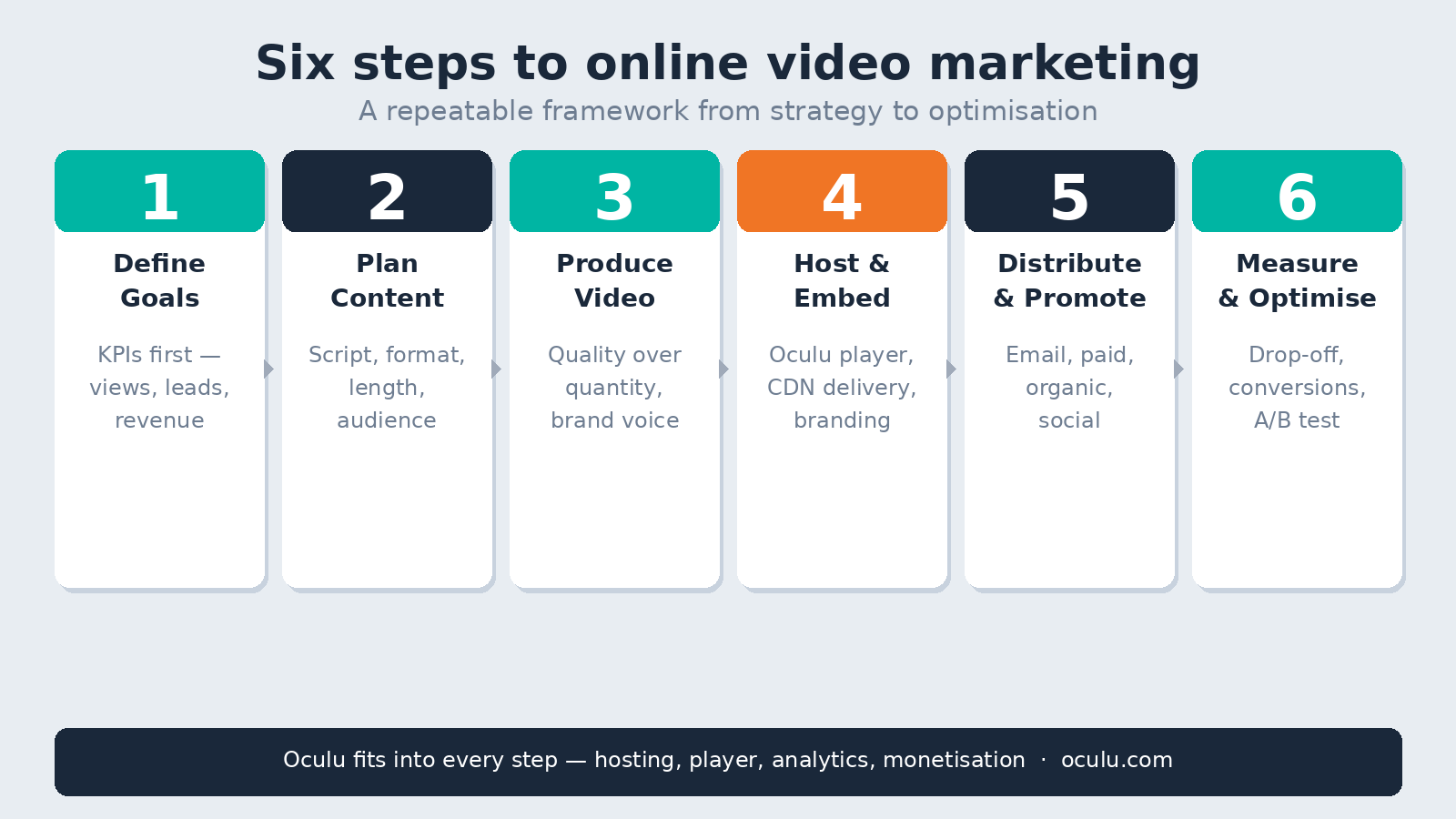
Successful online video marketing follows six steps: define clear business goals for each video, plan content that serves those goals, produce with quality in mind, distribute through the channels that reach the right audience, measure performance with real analytics, and optimize based on what the data shows.
For businesses treating video as a serious marketing channel — not just a content format — a repeatable framework is what separates video programs that drive pipeline from ones that simply produce content.
Why Online Video Marketing Needs a Framework
Video without a plan produces content. Video with a plan produces results. The difference is whether each decision — what to make, how to make it, where to put it, and how to improve it — is guided by clear goals or made ad hoc.
A six-step framework does not slow down video production. It prevents wasted effort by ensuring every video has a defined purpose, a defined audience, and a defined measure of success before a single frame is recorded.
Step 1: Define Your Video Marketing Goals
Before any production decision is made, define what the video is supposed to accomplish. Vague goals like “increase brand awareness” are harder to measure and optimize than specific ones.
Strong video marketing goals are specific and tied to business outcomes:
- Generate qualified leads from a defined audience segment
- Reduce support ticket volume by answering common questions on video
- Improve conversion rate on a specific landing page by adding a product demo
- Shorten the sales cycle by giving prospects education before the sales call
- Improve AI-search visibility for a topic by creating authoritative, structured video content
Step 2: Plan Content That Serves the Goal
Once the goal is clear, content planning becomes more straightforward. The video type, format, length, and tone should all follow from what the goal requires.
Questions worth answering before production:
- Who is the viewer, and what is their main question or objection?
- What is the one thing this video needs to communicate?
- Is this a standalone video or part of a series?
- Will it live on a landing page, product page, blog post, or social channel?
- Is AI-generated video a viable production path for this content type?
Step 3: Produce With Quality in Mind
Quality does not mean expensive. It means clear audio, adequate lighting, a focused message, and a production approach matched to the content type and channel.
For self-produced video, clear audio is usually the highest-leverage improvement. Viewers will tolerate average image quality far longer than bad sound. A microphone upgrade and basic lighting often matter more than camera equipment.
For businesses scaling video output — especially with AI-generated content — production quality also means consistency: consistent brand voice, visual treatment, and structure that viewers recognize across every video.
Step 4: Edit for Clarity and Conversion
Editing is where good raw footage becomes a video that holds attention and drives action. The goal of editing is not to show everything captured — it is to create a clear, compelling experience that ends with the viewer wanting to take the next step.
Strong editing principles for business video:
- Cut everything that does not serve the message
- Open with the strongest moment, not a slow build
- Keep pacing tight — remove dead air and repeated ideas
- End with a clear, specific next action for the viewer
Step 5: Distribute Through the Right Channels
A video that no one finds does not drive results. Distribution decisions should follow the goal from Step 1.
For conversion-focused video, the company website is the primary channel. For awareness and discovery, public platforms and social distribution expand reach. For sales enablement, direct sharing through email or CRM keeps the video in front of the right person at the right time.
Key distribution considerations:
- Host conversion-critical video on a professional platform to protect brand experience and analytics
- Use public platforms for discovery and top-of-funnel reach
- Ensure video pages include captions, metadata, and FAQ content for AI-search visibility
- Track which distribution channels generate real engagement and downstream action — not just views
Step 6: Measure, Learn, and Improve
Video performance data is only useful if it is acted on. The metrics worth tracking depend on the goal from Step 1, but several apply broadly:
- Completion rate: Are viewers watching through to the end?
- Engagement drop-off: Where are viewers leaving the video?
- Conversion correlation: Do viewers who watch the video convert at a higher rate than non-viewers?
- Distribution performance: Which channels generate engaged views that lead to action?
Most businesses find that a small number of videos drive the majority of results. The job of measurement is to identify those videos, understand why they work, and replicate the pattern.
Where Oculu Fits
Oculu supports all six steps of a business video marketing program. The platform handles hosting, branded playback, distribution, and analytics — and supports AI-generated video workflows for businesses scaling content production.
For companies building a repeatable video marketing operation, Oculu provides the infrastructure to test, measure, and improve video performance without sending viewers to platforms that do not share the data or serve the business’s interests.
Key Takeaway
Online video marketing works when each video has a clear goal, a focused message, a distribution plan, and a feedback loop. The six-step framework — goal, content, production, distribution, measurement, optimization — is how businesses turn video from a one-time investment into a compounding marketing asset.
Frequently Asked Questions
Define clear business goals, plan content that serves those goals, produce with quality in mind, distribute through the right channels, measure performance with analytics, and optimize based on what the data shows.
Very important. The hosting platform determines where viewer data goes, how the brand appears, whether the video loads reliably, and whether the experience supports conversion — all of which directly affect marketing results.
YouTube is useful for public discovery and awareness. For conversion-critical content like landing pages, product demos, and sales videos, a professional hosting platform gives the business more control over branding, analytics, and the viewer experience.