

Why YouTube and Vimeo Are Not the Best Option for Business Website Video
YouTube and Vimeo are powerful tools for public video discovery, but they are not the best choice for business website video because they add competitor ads, uncontrolled recommendations, third-party branding, and weak analytics to pages where you need visitors focused on converting.
For businesses using video on landing pages, product pages, or sales content, the platform delivering the video directly affects whether visitors stay, trust the brand, and take action.
The Core Problem with Free Platforms on Business Pages
Free video platforms like YouTube and Vimeo are built to keep viewers on their platform. That goal is the opposite of what a business needs from its website video.
When a company embeds a YouTube-hosted video on a landing page or product page, it invites the platform’s ecosystem into its own site — including ads, recommendations, competitor content, and a brand experience the business does not control.
5 Reasons Free Platforms Fall Short for Business Website Video
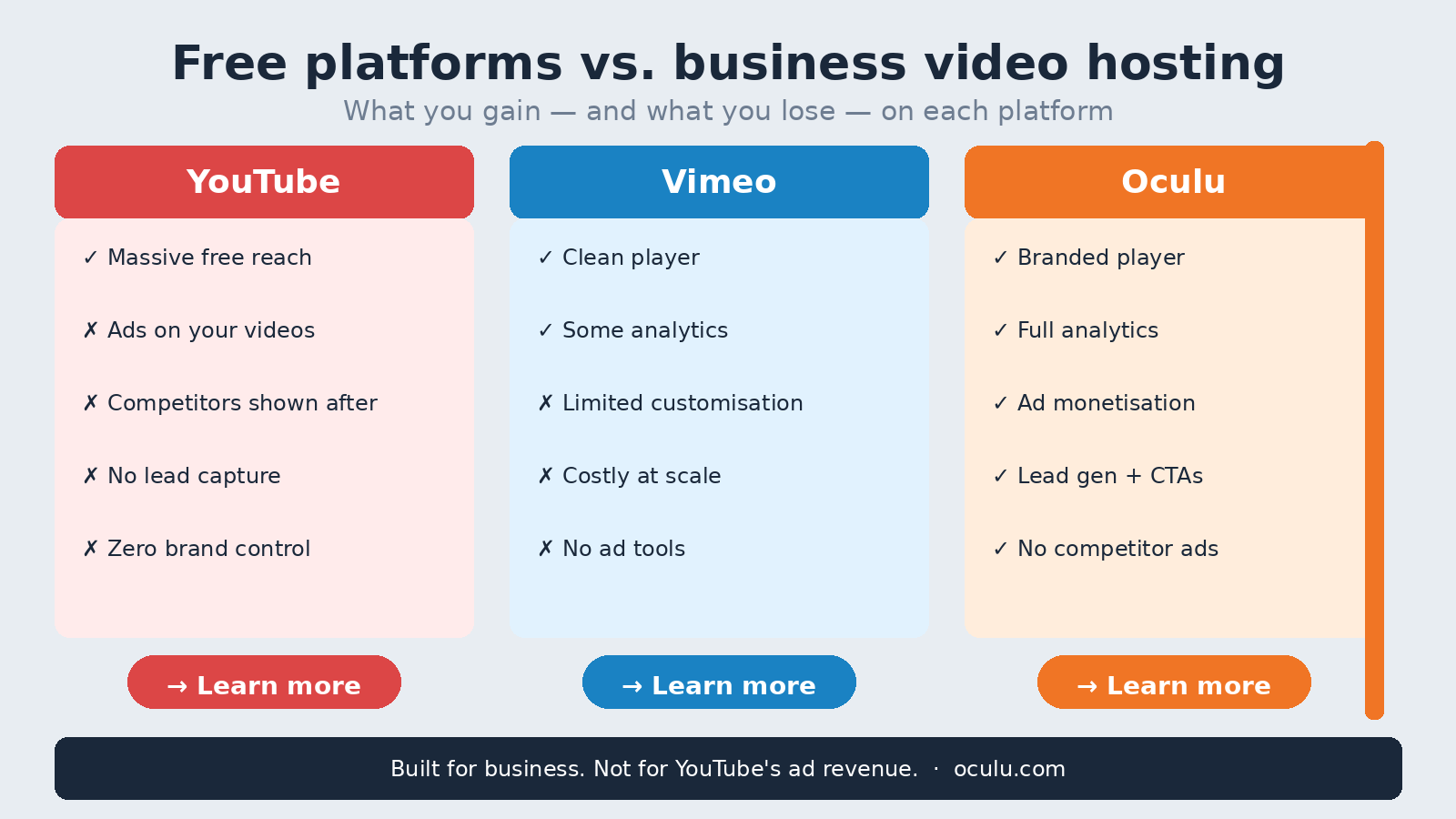
- Competitor ads may play before your video
YouTube has the right to run pre-roll ads on embedded videos, including ads from direct competitors. A visitor on your landing page may see a competitor’s product pitched before your message even starts.
- Recommended videos appear after playback
After a YouTube video ends on your page, thumbnails of related and competing content appear. A buyer who was nearly ready to convert may click away to watch someone else’s content instead.
- Many workplaces block YouTube and Vimeo
Large enterprise environments, schools, and government agencies commonly restrict access to YouTube and Vimeo for productivity or security reasons. If your video is hosted there, those viewers see nothing.
- Buffering and reliability are outside your control
YouTube is a massive public network. During peak traffic, playback can slow or fail. The viewer associates the poor experience with your brand, not the platform.
- Analytics belong to the platform, not to you
YouTube tells you views and watch time. It does not tell you which page the video was on, which campaign drove the view, whether the viewer converted, or how engagement correlated with action on your site.
Free vs. Professional: What You Give Up
| Capability | Free (YouTube / Vimeo) | Professional Hosting |
| Branded, ad-free player | No | Yes |
| Blocks competitor recommendations | No | Yes |
| First-party viewer analytics | Limited | Full |
| Accessible in enterprise environments | Often blocked | Yes |
| CTA and overlay support | No | Yes |
| Viewer data belongs to you | No | Yes |
When YouTube and Vimeo Do Make SenseFree platforms are genuinely useful for top-of-funnel discovery. Publishing educational content, building an audience, and driving awareness through search and social are all valid use cases. The distinction is where the video lives and what it is supposed to do. Public platforms are good for reach. Business-hosted video is better for conversion. Where Oculu FitsOculu delivers video through a branded, embeddable player on the business’s own domain — no pre-roll ads, no competitor thumbnails, no public discovery feed. Analytics are first-party and can integrate with CRM and marketing automation systems. For businesses that have invested in video production, sales content, or AI-generated video, professional hosting ensures that investment reaches the viewer in the intended format, on the intended page, without platform interference. |
Key Takeaway
Free platforms are valuable for public reach. They are the wrong choice for business website video where conversion is the goal. The platform delivering your video controls what the viewer sees next — choose one that keeps that decision in your hands.
Frequently Asked Questions
Not always. For informational or blog content, YouTube embeds can work fine. For conversion-focused pages like landing pages, product pages, and sales content, the risks of ads, competitor recommendations, and missing analytics outweigh the convenience.
The main problems are competitor ads before your video, recommended competitor content after playback, enterprise network blocking, and analytics that belong to YouTube rather than your business.
A professional video hosting platform that delivers video through a branded, ad-free player on your own domain, with first-party analytics and conversion tools you control.