

Direct Response Video Landing Pages Tips That Actually Convert
A direct response video landing page converts best when the video is placed above the fold, opens with a hook that matches the visitor’s intent, stays focused on one message and one action, uses captions for silent viewers, and is tested systematically to improve performance.
For businesses running paid campaigns or trying to convert inbound traffic, the way video is built into a landing page determines whether that traffic turns into pipeline.
Why Video and Direct Response Work Together
Direct response marketing is about getting one specific action from one specific visitor at one specific moment. Video supports this by reducing the cognitive effort required to understand the offer.
A visitor who arrives from a paid ad is already in a decision-making mindset. A short, well-placed video that immediately confirms they are in the right place — and explains the offer clearly — reduces hesitation and increases the likelihood of conversion.
6 Landing Page Principles That Apply Directly to Video
- Make the hook immediate
The first three to five seconds of a video work like the headline of a landing page. If they do not confirm relevance and create interest fast, the viewer leaves. Write the opening line of every video the same way you would write a headline: specific, benefit-led, and audience-aware.
- Keep the video above the fold
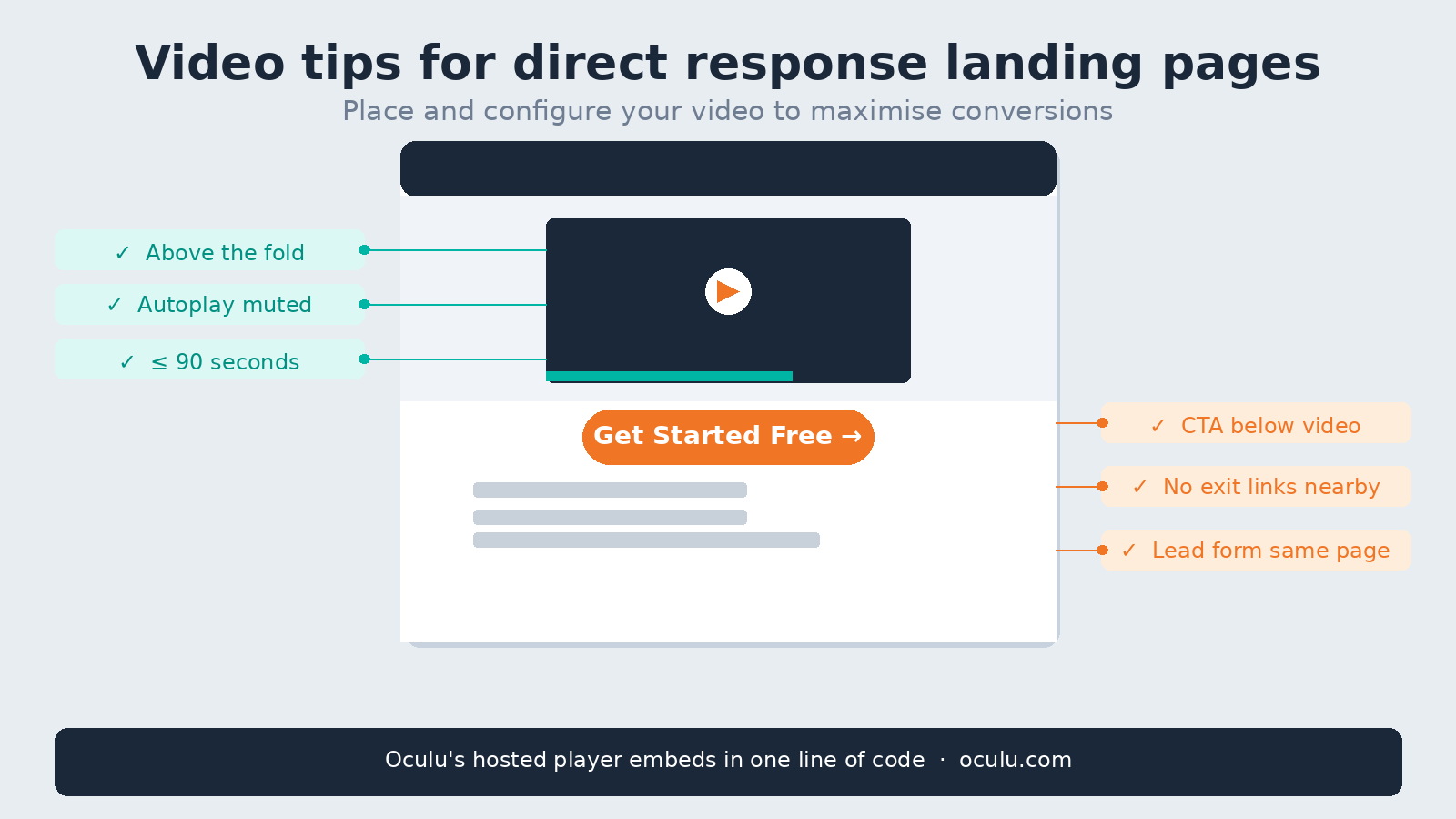
Video is the most important piece of content on a direct response page. Placing it below the fold requires the visitor to scroll before they engage — a friction point that reduces completion and conversion rates. The video should be visible immediately on page load.
- Remove everything that competes with the message
A cluttered page gives visitors reasons to leave without converting. Remove navigation menus, unrelated links, social media icons, and any content that does not directly support the conversion goal. Apply the same rule inside the video: remove company history, excessive branding, and anything not directly relevant to the offer.
- Match the video message to the CTA
The video should explain why the visitor should take the next action — not just what the company does. If the CTA is “Book a Demo,” the video should explain why the demo is worth booking. If it is “Start Free Trial,” the video should remove the objections that prevent sign-up.
- Use captions for silent viewing
A large share of website visitors watch video without sound, especially on mobile. Captions ensure the message lands regardless of audio. Captions also improve accessibility and support AI-search indexing of the video’s content.
- Test everything systematically
Direct response is a testing discipline. Video landing pages should be tested for video length, opening line, thumbnail, player format, CTA placement, and page layout. Small changes — like moving the CTA closer to the video — can have meaningful impact on conversion rates.
Player Format Matters for Direct Response
The video player format affects how visitors interact with the content. For direct response pages:
- Embed format keeps the video visible at all times — works well when the page is built around the video as the main asset
- Overlay format works when the existing page design cannot accommodate a large embed slot
- Lightbox format is generally a poor fit for lead-gen pages because it disables interaction with the rest of the page — including any form — while playing
Video Testimonials as Direct Response Tools
Text testimonials are standard on landing pages. Video testimonials are more powerful because they provide social proof in a format that is harder to fabricate and easier to believe. A short customer success story that directly addresses the main objection of the target audience can be one of the highest-converting pieces of content on the page.
What to Test on a Video Landing Page
Effective direct response pages use data, not assumptions. Key variables worth testing include:
- Video length — shorter is not always better; test 30s, 60s, and 90s versions
- Opening line — the first sentence determines whether viewers watch or leave
- Thumbnail image — the still frame before play affects click-through on user-initiated video
- CTA placement — above the video, beside it, or below it
- Player format — embed vs. overlay vs. autoplay silent preview
- Page copy — video plus copy vs. video only
Where Oculu Fits
Oculu supports direct response video experiences through branded embeds, overlay format options, CTA and end-card overlays, and analytics that show how video engagement correlates with conversion. For businesses running paid campaigns, Oculu keeps video on the company’s domain without the distraction risks of free platforms.
Key Takeaway
Direct response landing pages work when every element — including the video — serves one goal. The strongest video landing pages are built around a clear hook, a focused message, an above-the-fold player, and a systematic testing approach that treats video as a conversion variable, not a decoration.
Frequently Asked Questions
Above the fold, visible immediately on page load, and close to the primary CTA. Placing video below the fold reduces completion rates and weakens its impact on conversion.
Long enough to answer the visitor’s main question and address the key objection, short enough to hold attention. Most effective direct response videos run 60 to 120 seconds, though the right length depends on offer complexity and traffic source.
Silent autoplay can work for short preview formats, but user-initiated playback is safer for most pages. Test both and measure conversion impact rather than assuming one approach is universally better.