

AEO, GEO, Closed Captioning & SRT Files — It’s All AI Search Optimization
For years, SEO was easy to explain. You optimized pages, chased keywords, built links, and hoped Google smiled upon you.
Then AI showed up — and quietly rewrote the rules.
Today, search engines don’t just return links. They answer questions, summarize topics, explain concepts, and recommend solutions. And they do it using large language models, multimodal systems, and generative engines.
That shift has introduced a wave of new terms: AEO, GEO, closed captioning, SRT files — each describing part of how AI-powered search works.
Individually, they’re useful. Collectively, they can be confusing.
So let’s simplify things.
The truth is this:
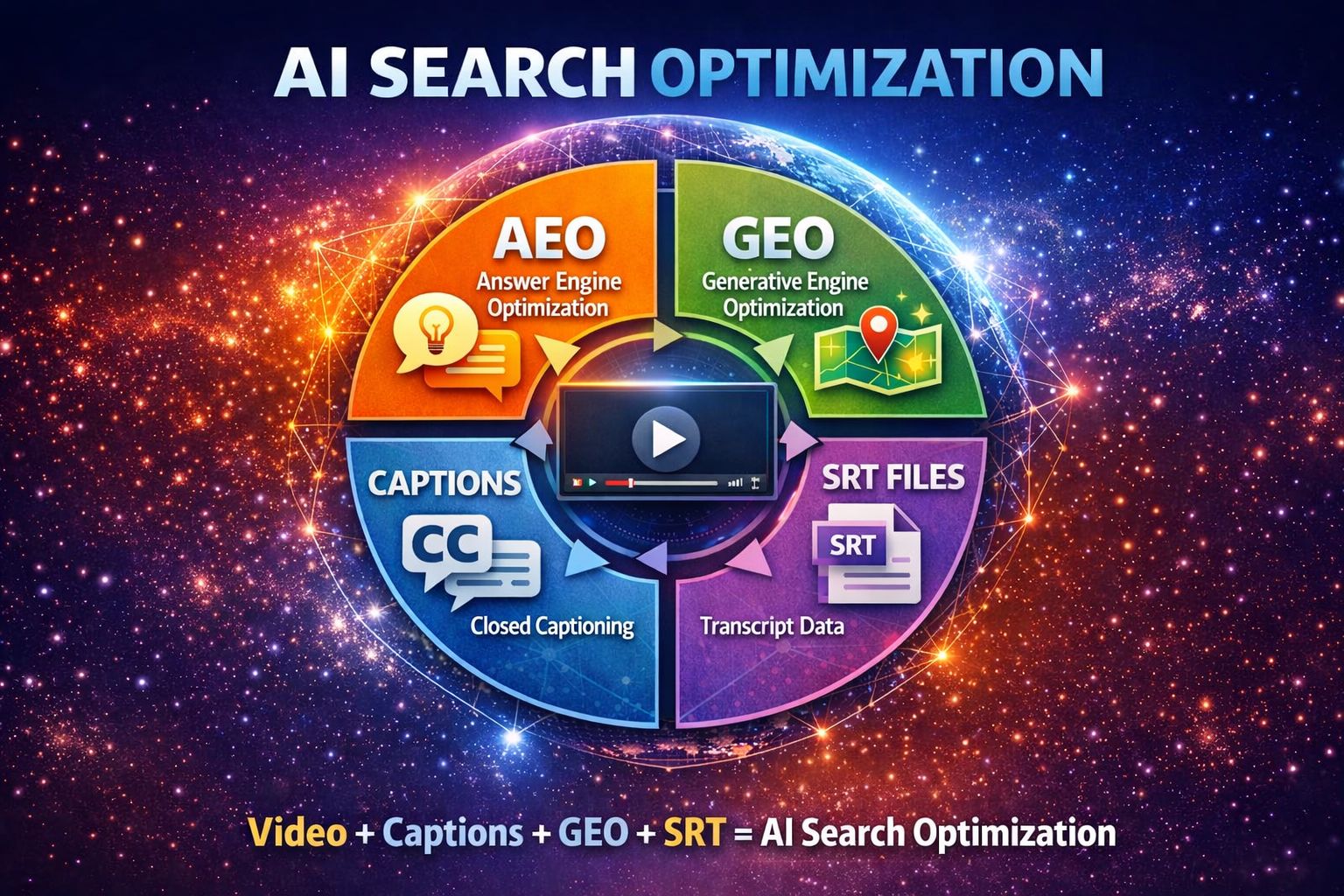
All of these elements belong to one discipline: AI Search Optimization.
And at the center of it all? Video — delivered through the right video player.
Let’s break it down.
AI Search Optimization: The Big Picture
AI Search Optimization is about helping AI systems understand, trust, and use your content.
Not rank it.
Not crawl it.
Use it.
Modern AI search engines don’t just scan pages — they interpret language, extract meaning, apply context, and generate responses. That means your content needs to be readable not just by humans, but by machines that think in language, structure, and probability.
This is where AEO, GEO, captions, and SRT files each play a role.
AEO: Answer Engine Optimization
AEO is the most literal evolution of SEO.
Instead of asking, “How do I rank?” AEO asks, “How do I become the answer?”
When someone asks an AI system a direct question — especially a conversational or voice-based one — the system looks for content that clearly, confidently, and concisely answers it.
That’s AEO at work.
In video, AEO shows up when a speaker clearly explains something in plain language. A single sentence, spoken naturally, can become the exact answer an AI assistant delivers to a user.
Of course, that only works if the AI can read the video — which is why captions matter so much.
GEO: Generative Engine Optimization
If AEO is about answers, GEO is about stories.
Generative Engine Optimization focuses on how AI systems build longer explanations and summaries. When an AI pulls together information from multiple sources to explain a topic, GEO determines who gets included — and how prominently.
GEO rewards depth, clarity, and authority. It favors content that explains ideas fully, uses natural language, and demonstrates real-world expertise.
This is where video shines.
A well-structured video doesn’t just state facts — it explains, demonstrates, and contextualizes. When paired with strong language signals and geographic relevance, it becomes the kind of source AI systems trust when generating responses.
Closed Captioning: Teaching AI to Listen
Here’s a simple truth:
AI doesn’t really watch video.
It listens.
Closed captioning turns spoken words into machine-readable language. Without captions, even the best video is mostly opaque to AI search systems.
With captions, everything changes.
Suddenly, your video has vocabulary, intent, tone, and meaning that AI can analyze. Captions allow AI to understand what is being said, how it’s being said, and why it matters.
They also happen to improve accessibility for humans — a rare win-win in technology.
SRT Files: Giving Video Structure and Memory
If closed captions give AI language, SRT files give it structure.
SRT files break captions into time-coded segments. That timing is critical. It allows AI systems to connect words to exact moments in a video.
This enables powerful capabilities: extracting specific answers, referencing precise clips, and understanding context at the moment level rather than the video level.
Think of SRT files as the table of contents for your video — except the reader is an AI system.
The Unsung Hero: The Video Player
All of these elements converge in one place: the video player.
In the age of AI search, the video player is no longer just a playback tool. It’s infrastructure.
A modern, AI-ready video player connects:
- Video and language (captions and SRTs)
- Video and location (geo metadata)
- Video and distribution (visibility and trust signals)
When those connections exist, video becomes legible, indexable, and trustworthy to AI systems.
When they don’t, video is just pixels and sound.
Why Geo-Aware Video Changes Everything
AI search cares deeply about relevance — and relevance is often local.
When video includes geographic signals alongside spoken context, AI systems gain a much clearer understanding of where the content applies.
A geo-aware video player allows AI to associate expertise with location, turning video into a powerful local authority signal.
This is especially important as AI search becomes more personalized, contextual, and location-sensitive.
Let’s Stop Inventing More Acronyms
AEO, GEO, captions, SRTs — they’re not competing strategies.
They’re components.
Trying to treat them separately only creates confusion in a world that already has enough buzzwords.
Instead, it’s time to rally around a single idea:
- AI Search Optimization
- AEO helps AI answer questions.
- GEO helps AI tell better stories.
- Captions give AI language.
- SRT files give AI structure.
- Video players bring it all together.
The Future of Search Is Video-Literate
AI search isn’t just reading web pages — it’s interpreting media, understanding language, and applying context.
Brands that succeed will be the ones that stop thinking of video as a supporting asset and start treating it as core search infrastructure.
Because in the AI era, video isn’t just something people watch.
It’s something machines learn from.
And the better they understand it, the more visible your brand becomes.
FAQ
AI Search Optimization is the practice of structuring content so AI-powered search engines can understand, trust, and use it when generating answers, summaries, and explanations.
It goes beyond traditional SEO by focusing on how AI systems interpret language, context, and media rather than just how pages rank in search results.
AEO helps AI systems answer direct questions clearly, while GEO helps AI systems generate longer explanations and summaries using your content as a trusted source.
AEO focuses on becoming the answer, whereas GEO focuses on shaping the story AI tells when explaining a topic.
Closed captions and SRT files are important for AI search because they turn video into machine-readable language and structured data that AI systems can analyze and reference.
Captions give AI the words it needs to understand video content, and SRT files add time-based structure that allows AI to extract specific answers and contextual moments accurately.