

Hollywood Is Panicking About AI Video. Businesses Should Be Paying Attention.
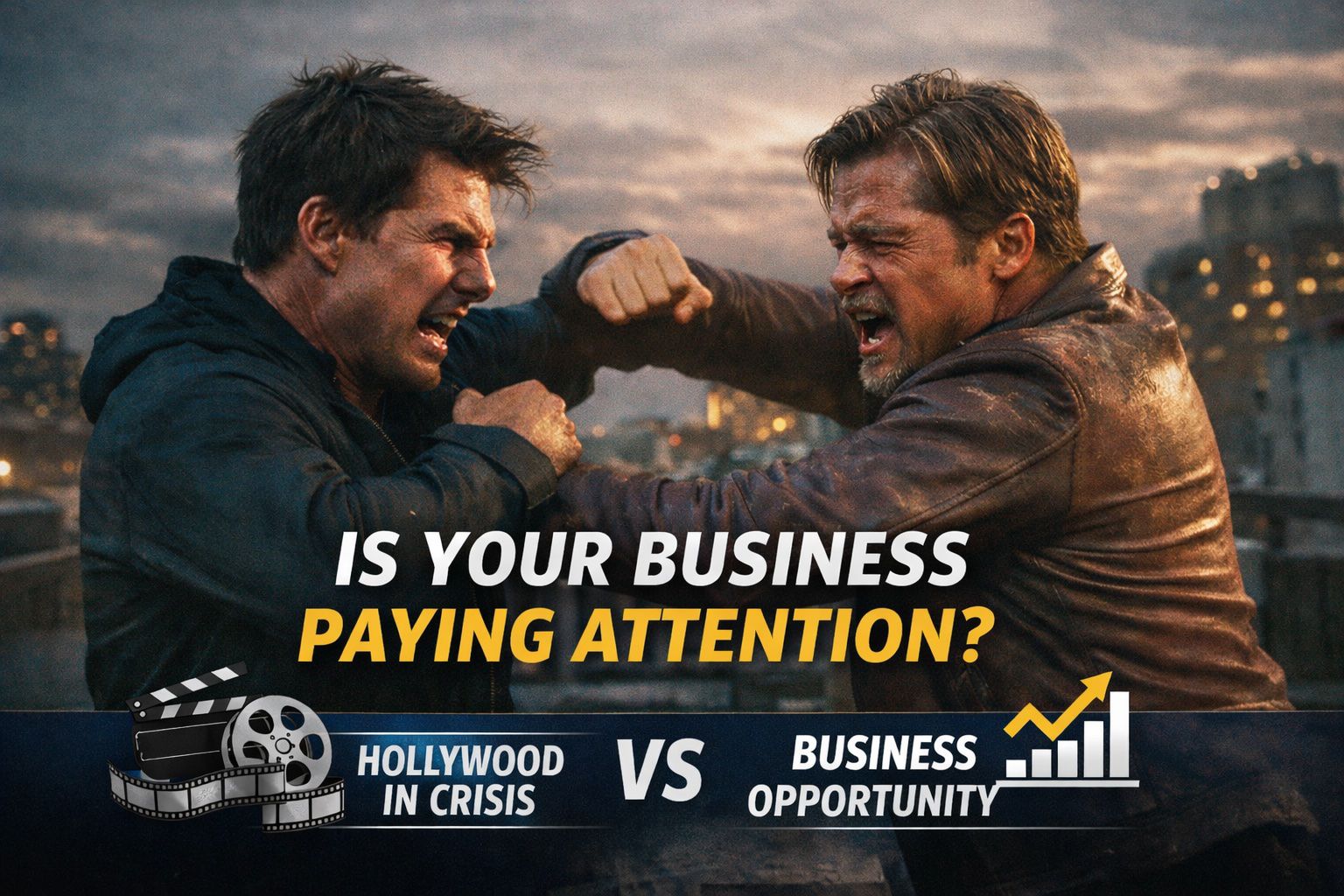
When a hyper-realistic AI-generated fight scene featuring digital versions of Tom Cruise and Brad Pitt went viral, Hollywood reacted exactly the way Hollywood tends to react when technology moves faster than expected — with drama.
Writers warned it was “over.” Producers questioned the future of filmmaking. Social feeds lit up with existential dread. The clip itself was only seconds long, but it crossed an important threshold: it looked real. Cinematic lighting. Convincing motion. Studio-level grit. And reportedly created with a simple prompt.
But if we’re being honest, this isn’t the first time the industry has faced a moment like this.
When digital cameras — especially the RED camera — began replacing traditional film, it was treated as a turning point that would destroy the art form. Panels were convened. Purists protested. Entire debates were framed around whether cinema itself would survive.
It did. And it evolved.
Today’s AI video moment feels remarkably similar. The difference is that while Hollywood reacts loudly, the business community is reacting quietly.
Fear in Hollywood. Hesitation in Business.
In entertainment, AI video is perceived as a threat. It challenges budgets, unions, workflows, and the mythology of production. When your industry is built on cameras, crews, and massive sets, the idea that one person with a laptop can generate something cinematic feels destabilizing.
In the business world, however, the response is different. It’s quieter. More cautious. Less dramatic.
When I speak with founders and executives about studio digital spokespersons—AI-powered video avatars trained from a professional green-screen session—the reaction is rarely panic. It’s usually curiosity mixed with distance.
“That’s interesting.” “We’re watching where this goes.” “Maybe next quarter.”
And yet, the same technology that is terrifying Hollywood is sitting right in front of businesses as an operational advantage. The irony is hard to miss. Hollywood sees loss. Businesses should see leverage.
The Technology Isn’t Coming. It’s Already Operational.
There’s a subtle but important misconception in the market right now. Many companies still treat AI video as something that’s “almost ready,” as if it’s a beta experiment waiting for maturity.
It isn’t.
Today, a founder can walk into a studio once, record high-quality green-screen footage under controlled lighting and professional audio, and have that performance trained into a digital spokesperson. Within days, that spokesperson can deliver new scripts on demand with realistic motion, voice cadence, and expression.
This means no booking crews every time you need an update, no rearranging schedules for internal announcements, and no spending three days producing a two-minute product video. You can still film whenever you want. You’re just no longer dependent on filming to stay consistent.
That’s not futuristic. That’s infrastructure. And infrastructure rarely feels dramatic. It feels practical — which might be why Hollywood is shouting while businesses are quietly shrugging.
Why the Resistance?
Part of the hesitation in business is emotional. Video is personal. It’s your face, your voice, your reputation. There’s an understandable instinct to protect that.
Another part is timing. When something feels new, it’s easy to assume it can wait.
But most resistance isn’t philosophical. It’s inertia.
Businesses are used to how they produce video. They accept the friction as normal: schedule the shoot, book the team, edit the file, repeat. What they often haven’t calculated is the cumulative cost. Over the course of a year, those small production cycles add up to hundreds of hours of executive time — hours that could be spent closing deals, building partnerships, or developing strategy.
The question isn’t whether AI replaces video production entirely. It doesn’t. The question is whether reducing friction creates an advantage.
History suggests it does.
The RED Camera Moment
When digital cameras disrupted film production, the early adopters weren’t the ones arguing on panels. They were the ones quietly building workflows around the new tools.
The same pattern is emerging now.
At first, AI video looks like novelty. Then it looks like efficiency. Eventually, it becomes expectation.
The companies that understand this shift early won’t necessarily be louder. They’ll simply be faster.
Hollywood is in its dramatic stage. The headlines are big. The tweets are emotional. The think pieces are flowing.
Meanwhile, the business opportunity is sitting there, waiting for someone to treat it like infrastructure instead of spectacle.
Where the Business Opportunity Is
The practical path forward for businesses is already clear.
Studio-grade digital spokespersons can be created through a controlled, professional process that starts with a one-time green-screen session. Lighting is balanced. Audio is clean. Framing is dialed in. The goal is to capture a performance that can be accurately modeled.
That footage is then trained into a realistic AI video avatar — your digital spokesperson. From there, you can generate new videos simply by entering text. The finished videos can be hosted, distributed, and optimized for modern search and generative discovery.
You’re not replacing yourself. You’re extending your presence.
And unlike a viral 15-second fight clip, this isn’t about spectacle. It’s about scale. It’s about consistency. It’s about reducing the operational drag of video production while maintaining professional quality.
Hollywood will continue debating whether AI changes everything.
For businesses, the better question is simpler:
If the technology is already here, why not use it?