


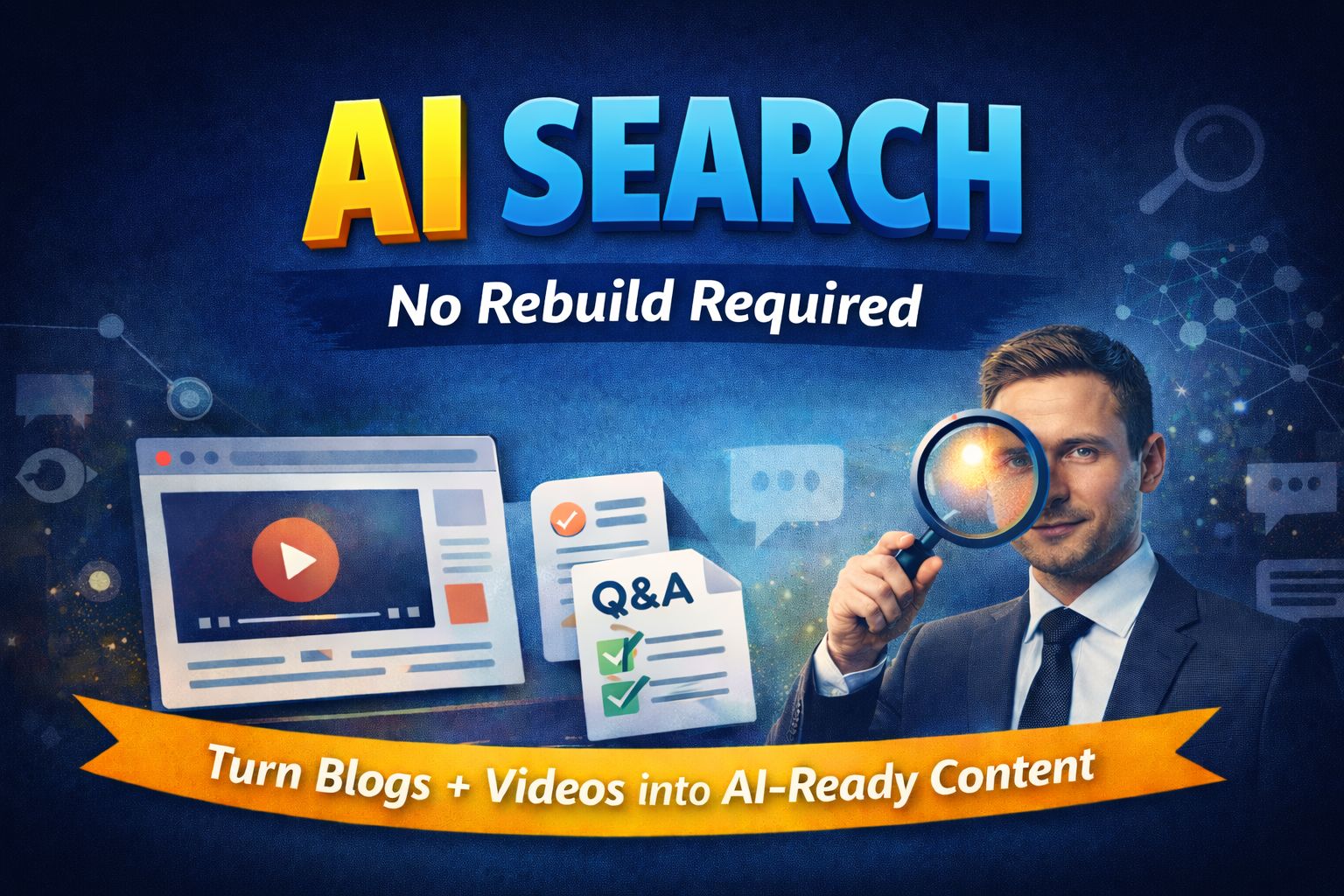
A Simple Way for Businesses to Show Up in AI Search—No Rebuild Required
Here is a practical way to use blog-style pages to start showing up in AI-driven search—without replacing your existing SEO strategy.
AI-driven tools like ChatGPT, Perplexity, and other emerging “answer engines” are quickly becoming part of the discovery process. Instead of scanning pages of links, users ask questions and expect clear, summarized responses. Behind the scenes, these systems are deciding which content to trust, reference, and surface.
The good news for businesses is that entering this new AI search world doesn’t require throwing out everything that already works. You don’t need to replace your existing SEO strategy, rebuild your website, or publish hundreds of new posts.
In fact, a potential effective approach right now is surprisingly simple.
The Emerging Model: AI-Search-Ready Content Pages
What’s starting to work better is a hybrid content model — one that combines:
- A short, focused blog-style page around a specific topic
- On-site video, embedded with a player that exposes metadata to the page
- Structured Q&A, designed for Answer Engine Optimization (AEO)
- Schema and context, so AI engines understand what the content actually means
Think of these pages less as “blogs” and more as AI-readable content hubs.
Each page is intentionally designed to answer a specific question or explain a single service, product, or idea clearly and completely. The goal isn’t volume — it’s clarity. Here is an example of this on our pricing page – Oculu – https://oculu.com/pricing/
Why This Works (and Why It’s Low Effort)
These pages don’t replace your existing website or SEO strategy. They sit alongside it.
A business might start with just one or two pages — for example, a key service offering or a high-value customer question. The content already exists in most cases. It’s simply being reorganized into a format that AI systems can better understand.
By embedding video directly on the page and pairing it with structured text and Q&A, the page provides multiple signals that reinforce the same topic. That redundancy is exactly what AI search engines look for when deciding whether content is trustworthy and relevant.
It’s a fast way to get into the AI search game without overcommitting resources or overhauling your entire marketing strategy.
Why Timing Matters Right Now
AI search platforms are still early in how they assess and rank content. Many businesses haven’t adapted yet, which means there’s less competition and more opportunity to establish authority.
Companies that start publishing a small number of well-structured, AI-friendly pages now are positioning themselves ahead of the curve — while continuing to benefit from traditional SEO at the same time.
This isn’t about chasing a trend. It’s about future-proofing content so it works for both humans and machines.
The Bottom Line
You don’t need to do everything at once.
Start small. Pick one topic. Build one AI-search-ready page. Add a video. Answer a few real customer questions. Let AI systems understand what you do — in your own words, on your own site.
That’s often all it takes to begin showing up in the next generation of search.
FAQ
Businesses can start showing up in AI search by creating focused, AI-search-ready content pages that combine clear written explanations, embedded video, and structured questions and answers.
This approach works alongside existing SEO and does not require replacing current pages, redesigning a site, or publishing large volumes of new content.
An AI-search-ready content page is a blog-style page designed to clearly explain one topic or service using structured text, on-page video, and AEO-formatted questions and answers.
These pages act as AI-readable content hubs, helping AI engines understand what the page is about, why it matters, and when it should be referenced in answers or summaries.
Adding video and structured Q&A helps content perform better in AI search because it provides multiple reinforcing signals that make the topic easier for AI engines to understand and trust.
When written explanations, video transcripts, metadata, and direct answers all align on the same page, AI systems are more likely to surface that content in responses.