


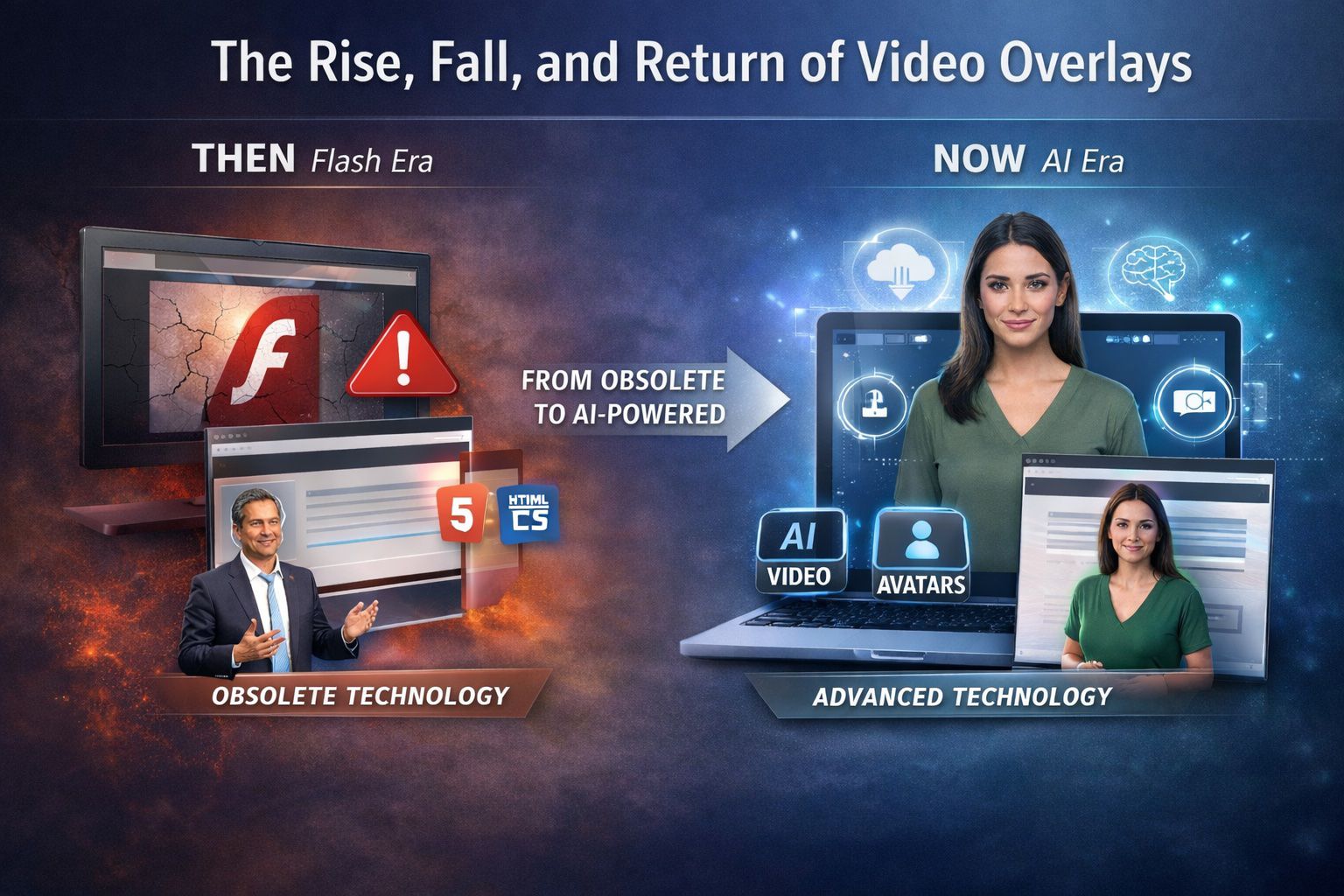
The Rise, Fall, and Return of Video Overlays
There was a time when video overlays represented one of the most compelling formats on the web.
Before autoplay feeds and skippable pre-roll ads became standard, brands experimented with video overlays that weren’t advertisements at all. Instead of interrupting content, a real person — often an actor or spokesperson — would appear layered on top of a company’s website, usually in the lower corner of the screen.
These overlays weren’t tied to ad placements or media buys. They were part of the website experience itself — designed to greet visitors, deliver a message, or guide attention without pulling users away from the page. The effect felt natural, human, and intentional.
Several companies built successful products around video overlays, and the results were clear: stronger attention, higher engagement, and messaging that felt more human than banners or traditional pre-roll.
So why did video overlays disappear?
When Flash Disappeared, So Did Video Overlays
Most early video overlay formats were built on Adobe Flash. At the time, Flash enabled advanced animation and layered video experiences directly in the browser. But as the web evolved, Flash became increasingly problematic.
Flash introduced serious security vulnerabilities, struggled with performance—especially on mobile devices—and required heavy system resources. As smartphones became the dominant way people consumed video, Flash-based experiences failed to scale.
At the same time, modern web standards emerged. HTML5, CSS, and JavaScript provided faster, safer, and more efficient alternatives without the need for plugins.
In 2020, Adobe officially ended support for Flash. By early 2021, major browsers blocked it entirely. Overnight, video overlays effectively vanished—not because the concept failed, but because the underlying technology became obsolete.
As the web transitioned away from Flash to HTML5, the original in-video overlay format quietly faded from the market.
The Idea Didn’t Fail — the Technology Did
Video overlays weren’t abandoned because they lacked impact. They disappeared because the infrastructure that supported them no longer existed.
For years, the industry relied on simpler formats: pre-roll, mid-roll, and static overlays outside the video frame. These formats were easier to deploy, but they lacked the presence and immediacy that made overlays effective.
Now, that’s changing.
Why Video Overlays Are Returning
Today’s web environment is fundamentally different from the Flash era.
Modern streaming technologies, browser-native rendering, and AI-generated video have made it possible to reintroduce overlays without performance or security concerns.
More importantly, AI video and avatars have changed how brands think about on-screen presence.
Instead of relying on repeated filming, companies can now create digital spokespersons and AI-generated presenters that appear on demand. These assets make video overlays scalable again—allowing a human presence to step into the video experience at exactly the right moment.
The technology is no longer plugin-based. It’s lightweight, adaptive, and built on standards designed for today’s browsers and devices.
A Familiar Format, Rebuilt for the AI Era
The new generation of video overlays isn’t about recreating Flash-era effects. It’s about restoring a proven concept—placing a human or message directly inside the video—using modern tools.
With AI avatars, adaptive streaming, and real-time rendering, video overlays can once again appear naturally within content. Not as distractions, but as intentional moments of communication.
As businesses increasingly adopt AI-generated video and digital spokespersons, video overlays are poised for a return. Not because they’re nostalgic—but because the conditions that once made them impossible no longer exist.
The format was ahead of its time.
Now, the technology has caught up.
Video overlays are back—rebuilt for a world powered by AI.
FAQ
Video overlays are on-screen video elements where a person or message appears layered on top of a webpage or video to guide, explain, or communicate without interrupting the experience.
Historically, overlays placed a human presence directly inside the content, creating more natural engagement than banners or traditional ads.
Video overlays disappeared because they were largely built on Adobe Flash, which became insecure, inefficient, and incompatible with modern browsers and mobile devices.
When Flash was officially discontinued, the technology supporting early overlay experiences vanished—even though the overlay concept itself remained effective.
Video overlays are returning because modern web standards and AI-generated video make it possible to deliver human-like on-screen presence without the technical and performance issues of the Flash era.
AI avatars and digital spokespersons allow overlays to scale, adapt, and appear at the right moment, restoring a proven format using technology built for today’s web.